DVFS Explained: Dynamic Voltage and Frequency Scaling
DVFS lets a chip lower its voltage and clock speed when demand drops, cutting power sharply. How it works, why voltage matters most, and its trade-offs.
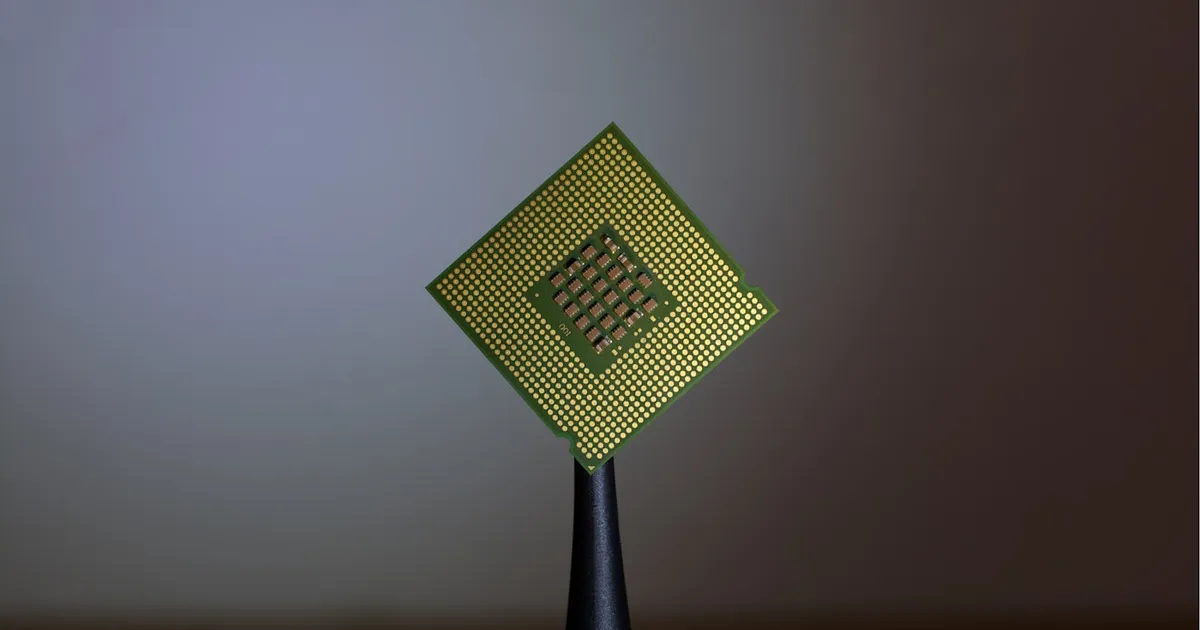
Dynamic voltage and frequency scaling (DVFS) is the technique processors use to adjust their supply voltage and clock frequency on the fly, running fast when there is work to do and slowing down when there is not. Because a chip’s power draw rises with the square of its voltage, even modest reductions in voltage and frequency save a disproportionate amount of energy. Nearly every modern CPU, GPU, and mobile system-on-chip relies on DVFS.
Why voltage and frequency move together
A digital circuit switches transistors on and off every clock cycle. Each switch charges or discharges tiny capacitances, and that consumes energy. The standard approximation for this dynamic power is:
P_dynamic ≈ α · C · V² · f- α is the activity factor — the fraction of transistors switching each cycle.
- C is the switched capacitance, fixed by the chip’s design.
- V is the supply voltage.
- f is the clock frequency.
Frequency appears linearly, but voltage appears squared. Lowering frequency alone reduces power proportionally. Lowering voltage reduces it quadratically.
The catch is that you cannot drop voltage freely. Transistors switch more slowly at lower voltage, so a given voltage can only sustain a certain maximum frequency before signals fail to settle within a clock cycle. Raising the clock usually requires raising the voltage too. This is why the two are scaled together as pairs called operating points: each frequency step comes with the minimum voltage that reliably supports it.
Put those relationships together and the payoff becomes clear. If you lower frequency and voltage together, power falls roughly with the cube of the scaling factor, while performance falls only linearly. Running at a somewhat lower speed can cut power dramatically.
Operating points and P-states
Chips expose their operating points as a table of discrete levels. On x86 systems these are traditionally called P-states (performance states), defined in the ACPI standard. P0 is the highest-performance state; higher numbers mean lower frequency and voltage.
| Higher P-state (e.g. P0) | Lower P-state (e.g. Pn) | |
|---|---|---|
| Clock frequency | Highest | Lowest |
| Supply voltage | Highest | Lowest |
| Dynamic power | Highest | Lowest |
| Heat output | Highest | Lowest |
| Typical use | Bursty interactive work, compiles | Idle background tasks |
P-states are distinct from C-states, which describe idle sleep levels where parts of the core stop clocking entirely or lose power. DVFS governs how fast a core runs while it is active; C-states govern how deeply it sleeps when it is not. The difference between clock gating and power gating maps closely onto those deeper idle states.
Who decides the operating point?
Something has to pick the right operating point many times per second. Historically, that was the operating system.
On Linux, the cpufreq subsystem uses governors — policies that set frequency based on load. Common examples include performance (always run at maximum), powersave (stay low), and schedutil (take frequency hints directly from the kernel scheduler’s view of utilization). Windows exposes similar choices through its power plans.
Modern processors increasingly make these decisions in hardware. Intel’s Hardware P-States (marketed as Speed Shift) and AMD’s CPPC-based approach let the OS state a preference — favor performance or favor efficiency — while on-chip firmware chooses the actual operating point. Hardware can react far faster than an OS timer, which matters for short bursts of work like a click handler or a page render.
GPUs and mobile SoCs do the same thing with their own power-management controllers, often scaling the graphics engine, memory controller, and individual CPU clusters independently.
Voltage domains: per-core vs shared
How granular DVFS can be depends on how the chip is wired. Each independently adjustable region is a voltage domain (or frequency domain).
- Shared domains are simpler and cheaper. All cores in a cluster run at the same voltage, so one busy core forces its idle neighbors up with it.
- Per-core domains let each core settle at its own operating point. They save more energy on mixed workloads but require more on-chip voltage regulators and more complex control.
Heterogeneous designs that pair performance and efficiency cores, common in phones and increasingly in laptops, combine DVFS with task placement. The scheduler can move light work to efficiency cores and run those cores at low operating points. The Arm vs x86 comparison touches on how this design philosophy shaped mobile chips first.
Boost, turbo, and thermal limits
DVFS also works upward. Turbo or boost modes push frequency and voltage above the rated base clock when the chip has thermal and electrical headroom — for example, when only a few cores are busy. The chip keeps boosting until it hits a limit on power, current, or temperature.
That makes DVFS central to how a processor lives within its thermal design power. When heat builds up faster than the cooler can remove it, the controller steps down to lower operating points. Push that far enough and you get thermal throttling, which is essentially DVFS acting as a safety valve.
Manual overclocking is the enthusiast version of the same idea: picking a higher operating point than the vendor validated, usually with extra voltage and extra cooling to keep it stable.
Race-to-idle vs slow-and-steady
There is a long-running debate about the most efficient way to finish a fixed amount of work.
- Race-to-idle says run at high speed, finish quickly, and drop into a deep sleep state as soon as possible. Static leakage power and the rest of the system (memory, display, radios) keep drawing power the whole time the CPU is busy, so finishing sooner can save total energy.
- Slow-and-steady says run at a low operating point, because the cubic power relationship means each unit of work costs less energy at lower voltage.
Neither is always right. The answer depends on how much power the rest of the platform draws, how deep the sleep states are, and how much leakage the process technology has. Modern power managers effectively look for the operating point that minimizes energy per task rather than following either rule blindly.
Why DVFS matters more than it used to
For decades, Dennard scaling meant each new process generation lowered voltage automatically, so chips got faster without getting hotter. That free lunch ended when voltages could no longer drop much further without excessive leakage. Since then, power and heat — not transistor count — have been the main constraints on performance.
DVFS is one of the primary tools designers use to work within that constraint. Combined with clock speed and IPC trade-offs, it determines how much real-world performance a chip can deliver inside a fixed power budget, whether that budget is a phone battery or a data-center rack.
The takeaway
DVFS lowers a chip’s voltage and frequency together when full speed is not needed, and because dynamic power scales with voltage squared, the savings are large. Processors expose discrete operating points, and the OS or on-chip firmware picks among them many times per second. The same mechanism powers turbo boost on the way up and thermal throttling on the way down. Whenever a laptop runs cool at idle and sprints during a compile, DVFS is doing the work.
Tagged
Keep reading
 Chisato · · 5 min read
What Is CPU Microcode? The Layer Below Machine Code
CPU microcode is the internal firmware that translates complex instructions into simple hardware operations. How it works, why it gets updated, and the risks.
 Chisato · · 4 min read
What Is SerDes? Serializer/Deserializer Chips Explained
SerDes converts parallel data to a serial stream for transmission and back, letting chips move data over fewer, faster wires with less overhead.
 Chisato · · 4 min read
DRAM vs SRAM: How the Two Main Memory Types Differ
DRAM stores each bit as a charge in a capacitor that needs constant refreshing; SRAM stores each bit in a transistor circuit that holds its state.