What Is CPU Microcode? The Layer Below Machine Code
CPU microcode is the internal firmware that translates complex instructions into simple hardware operations. How it works, why it gets updated, and the risks.
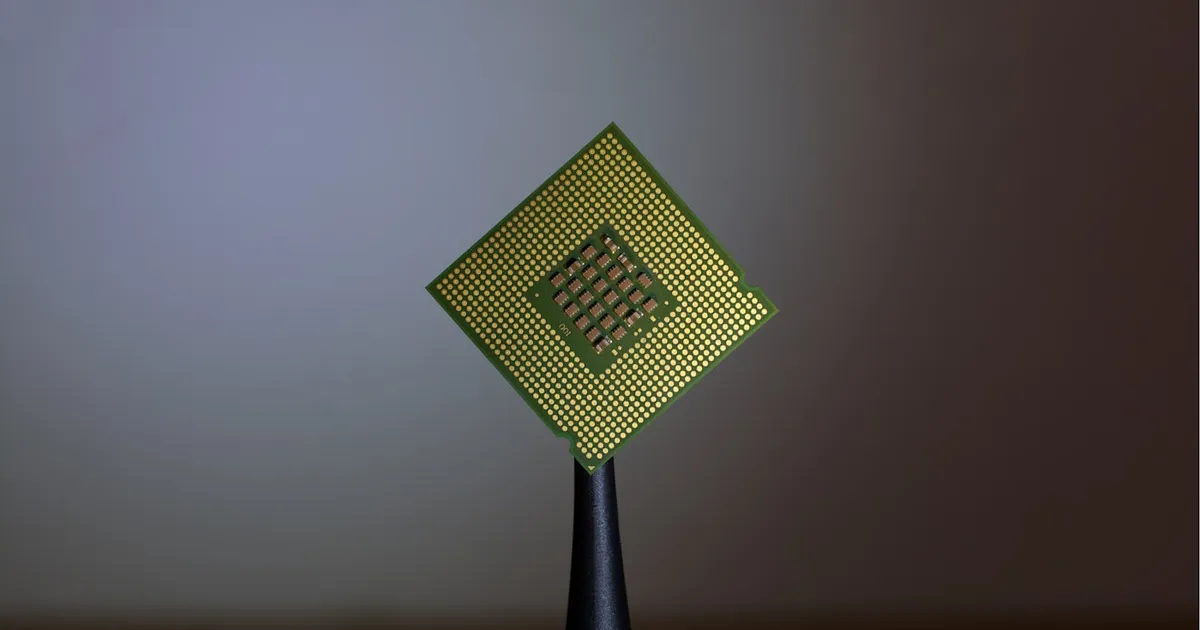
CPU microcode is a layer of low-level instructions inside the processor that implements some of the machine instructions software actually uses. When a program runs an x86 instruction, the CPU doesn’t always execute it directly in hardwired logic. For complicated instructions, it looks up a short internal routine of simpler steps, called micro-operations, and runs those instead. That routine is microcode. It sits beneath the instruction set architecture, invisible to the operating system, and it can often be patched after the chip has shipped, which is why “microcode update” shows up in firmware and OS security bulletins.
Where microcode sits in the stack
It helps to picture the layers from top to bottom:
- Source code — what developers write.
- Machine code — the instructions defined by the instruction set architecture (ISA), such as x86-64 or Arm. This is what compilers emit.
- Micro-operations — the small, fixed-format internal operations the execution units actually perform: load, add, compare, store.
- Hardware — the transistors and wires.
The front end of a modern CPU decodes machine instructions into micro-operations. For most common instructions, the decoders do this with fixed logic, producing one or a few micro-ops very quickly. For the rare, complex, or messy cases, the decoder hands off to the microcode sequencer, which reads a sequence of micro-ops out of an internal ROM.
Why processors need microcode at all
Microcode exists because some instructions are too complex to implement cleanly in fixed logic. In CISC designs like x86, a single instruction can copy a whole block of memory, perform string operations, switch privilege levels, or manipulate system registers. Building all of that as dedicated circuits would cost enormous die area for instructions that run infrequently.
Instead, the designer builds a fast, simple core that executes basic micro-operations, and expresses the complicated instructions as microcode programs running on that core. This has several advantages:
- Smaller, simpler hardware. Rare instructions don’t need their own circuits.
- Backward compatibility. Old instructions that modern software seldom uses can be kept alive as microcode rather than dedicated logic.
- Fixability. If an instruction is implemented incorrectly, the microcode can sometimes be corrected without new silicon.
RISC designs, which favor simple, uniform instructions, rely far less on microcode, but the distinction has blurred. High-performance cores in both camps break instructions into internal operations before feeding them into the instruction pipeline.
Microcode ROM and patch RAM
The base microcode is burned into read-only memory on the die at manufacturing time. To allow fixes, modern x86 processors also include a small area of writable patch memory. A microcode update loads a new routine into that patch area, and the CPU uses it in place of the ROM version for the affected instructions or behaviors.
Two properties of this patch memory are important:
- It’s volatile. Updates don’t persist across a power cycle. They must be reapplied every boot.
- It’s authenticated. Vendors sign and encrypt their microcode updates, and the processor verifies the signature before accepting one. This prevents arbitrary code from being loaded into one of the most privileged places in the machine.
How updates get applied
Because the patch area is wiped on every reset, something has to load the update early each time the system starts. There are two main paths:
- Firmware. The system’s UEFI firmware carries a microcode blob and applies it very early in boot, before the operating system loads. Updating the firmware updates the microcode it ships.
- Operating system. Linux, Windows, and other kernels can load a newer microcode update during early boot, overriding whatever the firmware applied. Linux distributions typically ship these as a separate package.
The OS path matters because firmware updates depend on the motherboard or laptop vendor, who may be slow to release them or may stop supporting older machines entirely. The OS route lets security fixes reach users regardless.
Why microcode updates often fix security problems
Microcode has become a key tool for mitigating hardware vulnerabilities. Many high-profile CPU flaws involve speculative execution, where the processor guesses ahead and leaves measurable traces in caches even when the guess is discarded. Those traces can be exploited as a side-channel attack to read data across security boundaries.
The underlying design can’t be changed in shipped chips, but microcode updates can:
- Add new control bits that let the OS flush or partition internal buffers on context switches.
- Change how particular instructions behave so that they act as speculation barriers.
- Disable or restrict a problematic feature entirely.
These mitigations frequently come with a performance cost, because they turn off optimizations the chip was designed around. That’s why benchmarks before and after a security microcode update sometimes differ noticeably on certain workloads.
Microcode updates also fix non-security errata: rare calculation errors, hangs under specific conditions, power management bugs, and stability problems.
Risks and limits
Microcode is powerful, but it isn’t a universal fix.
- Not everything is patchable. Behavior implemented purely in hardwired logic can’t be changed by microcode. Some flaws can only be mitigated in software or fixed in a new chip revision.
- Updates can regress. A microcode change that fixes one bug can introduce instability, and vendors have occasionally had to pull updates.
- Trust is concentrated. Only the vendor can produce valid updates, and the contents are opaque. You’re trusting the vendor’s signing process and its engineering.
For most users, the practical rule is simple: keep both firmware and the OS microcode package current, especially on servers and machines that run untrusted code alongside sensitive workloads.
The takeaway
Microcode is the processor’s internal firmware: routines of simple micro-operations that implement complex machine instructions and certain internal behaviors. Its ROM is fixed at manufacture, but signed, volatile patches can be loaded every boot by UEFI firmware or the operating system. That patch path has become an essential way to fix CPU errata and mitigate speculative-execution vulnerabilities, at the cost of some performance and a great deal of trust in the chip vendor.
Tagged
Keep reading
 Chisato · · 4 min read
What Is SerDes? Serializer/Deserializer Chips Explained
SerDes converts parallel data to a serial stream for transmission and back, letting chips move data over fewer, faster wires with less overhead.
 Chisato · · 4 min read
DRAM vs SRAM: How the Two Main Memory Types Differ
DRAM stores each bit as a charge in a capacitor that needs constant refreshing; SRAM stores each bit in a transistor circuit that holds its state.
 Chisato · · 4 min read
Von Neumann vs Harvard Architecture Explained
Von Neumann shares one memory for code and data; Harvard architecture splits them. How the two computer architectures differ, and where each is used.