Thermal Interface Materials Explained
Thermal interface material fills microscopic gaps between a chip and its heatsink so heat can actually transfer to the cooler.
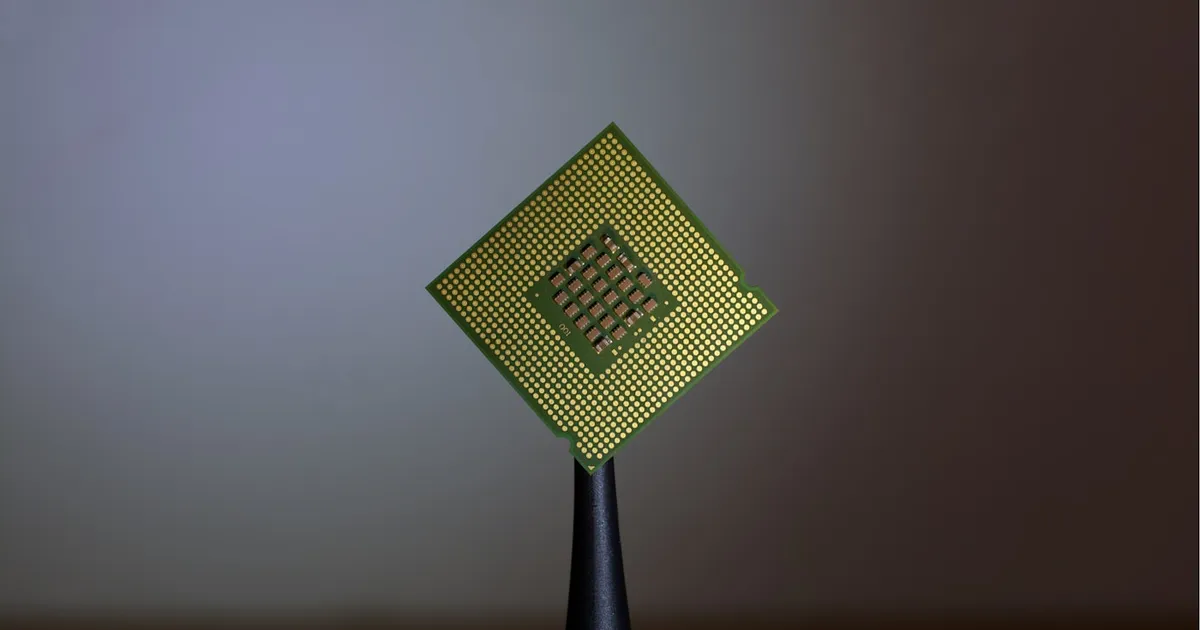
A thermal interface material (TIM) is a substance applied between a chip and its heatsink to fill the microscopic gaps left by both surfaces’ imperfections, since no manufactured surface — however precisely machined — is actually flat at a microscopic scale. Without a TIM, those gaps fill with air, which is a poor conductor of heat, and heat transfer between the chip and the cooler drops sharply no matter how capable the heatsink itself is.
Why direct metal-to-metal contact isn’t enough
At a macroscopic level, a processor’s heat spreader and a heatsink’s contact plate look flat and smooth. Under magnification, both surfaces have tiny peaks and valleys — machining tolerances measured in micrometers. When pressed together, only a small fraction of the total surface area actually makes direct contact; the rest is separated by microscopic air gaps. Air conducts heat far worse than metal, so those gaps act as an insulating layer exactly where heat needs to flow most efficiently.
A TIM fills those gaps with a material that conducts heat far better than air, even though it typically conducts worse than the metal on either side of it. The goal isn’t to be the best possible conductor — it’s to eliminate the far worse conductor (air) that would otherwise occupy the space.
Common types of TIM
- Thermal paste (grease). A viscous compound, often based on silicone, ceramic, or metal particles suspended in a carrier, applied as a thin layer between chip and heatsink. It’s the most common TIM in consumer hardware because it’s inexpensive, reapplicable, and conforms well to microscopic surface irregularities.
- Thermal pads. Pre-formed solid or semi-solid sheets, easier to apply consistently than paste (no risk of over- or under-application) but generally less thermally efficient, and mainly used where slightly worse performance is an acceptable trade for simpler assembly, such as cooling memory modules or voltage regulators.
- Liquid metal. Typically a gallium-based alloy, liquid at room temperature, offering substantially higher thermal conductivity than paste. It’s electrically conductive, though, which makes a spill onto exposed circuitry a real risk, and it can corrode bare aluminum over time — properties that keep it out of mass-market pre-built systems despite its performance advantage.
- Solder-based TIM. Used between the chip die and its heat spreader in some high-performance processors (rather than between the heat spreader and an external cooler), soldered TIM offers better conductivity and long-term stability than paste but costs more to manufacture and can’t be reapplied once assembled.
Why TIM choice and application matter in practice
A high-quality heatsink paired with poorly applied or degraded TIM will underperform a modest heatsink with a proper thermal interface — the interface is often the actual bottleneck, not the cooler’s raw capacity. This is directly relevant to thermal throttling: a chip that throttles under sustained load despite an apparently adequate cooler is worth checking for TIM issues — insufficient paste, an unevenly seated cooler, or paste that has dried out and lost effectiveness over years of thermal cycling.
TIM condition also interacts with a chip’s thermal design power rating. TDP describes how much heat a cooling solution needs to dissipate under sustained load; it assumes a properly functioning thermal interface. A degraded TIM effectively raises the real-world thermal resistance between chip and cooler, so a cooling solution rated for a chip’s TDP on paper can still fail to keep up if the interface itself is the weak link.
TIM and manufacturing yield
Thermal performance also factors into how chips are sorted after manufacturing. During chip binning, some of the variation in how a die actually performs under load traces back to how efficiently heat can be extracted from it — a chip that runs hotter for the same workload may be binned differently even if the silicon itself is comparable, because the practical ceiling on sustained clock speed depends on keeping the die below its thermal limits. This is also part of why overclocking enthusiasts often pay close attention to TIM choice: pushing a chip beyond its rated clocks raises heat output, and a marginal thermal interface becomes the limiting factor before the silicon itself does.
A brief note on manufacturing context
TIM sits at the very end of the chain described in how computer chips are made — after a die is fabricated, packaged, and mounted, the thermal interface is what connects that finished package to whatever cooling solution the end product uses, whether that’s a laptop’s heat pipe, a desktop tower cooler, or a data center’s liquid cooling loop.
The takeaway
Thermal interface material exists to eliminate the insulating air gaps left by microscopically imperfect surfaces between a chip and its cooler. Paste is the common, reapplicable default; pads trade some efficiency for simpler assembly; liquid metal and solder trade cost and handling risk for meaningfully better conductivity. Whatever the cooler’s rated capacity, a degraded or poorly applied TIM is often the actual reason a chip runs hotter or throttles sooner than expected.
Keep reading
 Chisato · · 4 min read
 Clock Speed vs. IPC: What Actually Makes a CPU Fast
Clock speed measures cycles per second; IPC measures work done per cycle. Real CPU performance is the product of both, not either one alone.
 Chisato · · 4 min read
 UMA vs NUMA: Memory Architecture Explained
UMA gives every CPU core equal-latency memory access; NUMA gives each core faster access to its local memory bank. How the two architectures differ.
Chisato · · 5 min read What Is Overclocking?
Overclocking runs a CPU, GPU, or memory beyond its rated clock speed for more performance, trading power, heat, and stability margin to get it.