Why Chip Stocks Fell Aug 18: Bond Yield Rout Explained
Semiconductors led a broad selloff on August 18, 2026 as the 30-year Treasury yield hit a 19-year high and AI valuation worries resurfaced. Here's why.
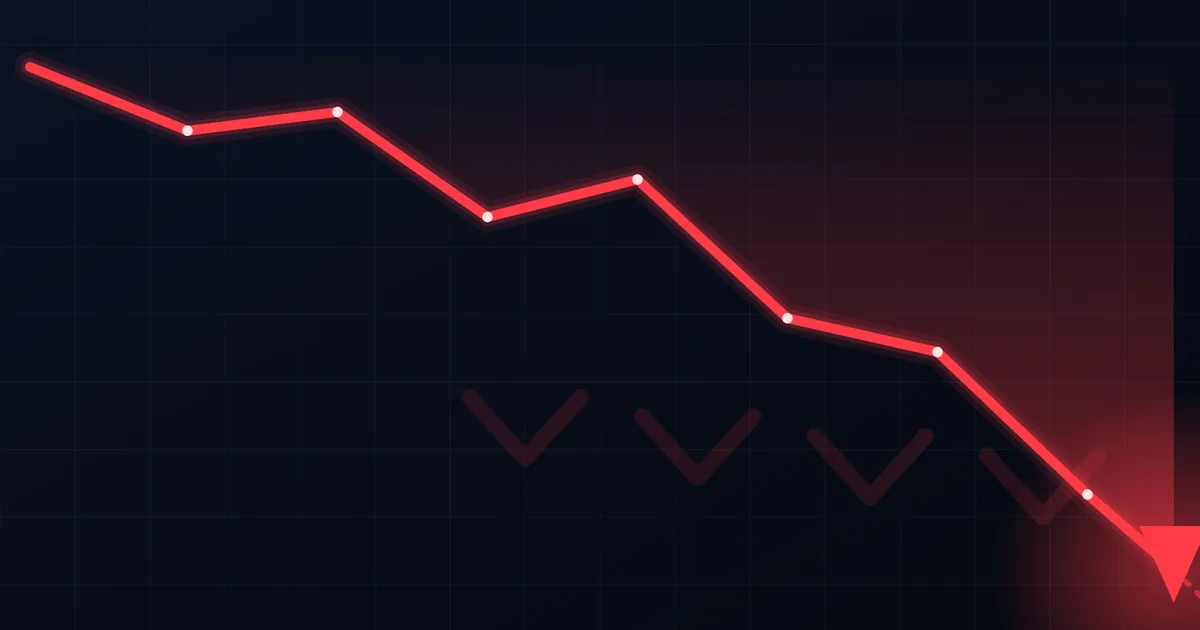
Wall Street’s most crowded trade cracked again on Tuesday, August 18. A sharp selloff in semiconductor stocks, coupled with another leg higher in long-term Treasury yields, dragged the major U.S. equity benchmarks lower and handed the S&P 500 its third straight losing session. The chips that have led the market for most of 2026 were, once again, the epicenter of the damage.
The Nasdaq Composite fell about 1.3% to close near 26,290, while the S&P 500 slipped roughly 0.7% to about 7,692. The tech-heavy Nasdaq 100 dropped closer to 1.7%. A closely watched gauge of semiconductor firms sank about 5.5% on the session — one of its worst single days since the summer’s memory-driven routs — even as pockets of the market, notably energy shares, held up against the tide.
What sold off
The selling was concentrated in the highest-beta corner of the tape: memory and storage. Marvell Technology and Seagate Technology were among the day’s steepest decliners, each falling on the order of 8% to 9%, and SanDisk posted a similarly heavy loss. Western Digital slid roughly 5%, Micron Technology fell around 4%, and Advanced Micro Devices (AMD) dropped about 3%. American depositary shares of Korea’s memory champions came under pressure alongside their U.S.-listed peers.
The pattern is familiar to anyone who followed this year’s earlier drawdowns. Memory is the tightest, most cyclical link in the AI supply chain, and it tends to move first and hardest in both directions. When traders reach for the sell button on the AI trade, HBM and NAND names are usually the first casualties — a dynamic that played out in the July memory rout that pushed the Nasdaq into a correction and again in the early-July chip selloff.
What made Tuesday different was the driver. This was not a headline out of Seoul or a single disappointing earnings print. It was the bond market.
The yield shock
The proximate trigger was a fresh surge in long-dated government debt yields. The U.S. 30-year Treasury bond yield climbed to its highest level in roughly 19 years, a multi-decade milestone that rippled straight into the equity market’s most expensive names. The move came amid renewed worry about sticky inflation, elevated oil prices, and the sheer volume of government borrowing that markets are being asked to absorb.
Higher long-term yields matter most to the stocks whose value depends heavily on profits far in the future. Semiconductor and AI-infrastructure names have been priced for years of compounding growth; when the rate used to discount those future cash flows rises, the present value of that growth shrinks — and the richest valuations take the biggest hit. It is the mechanical, unglamorous math that turns a bond-market move into an equity-market rout.
Compounding the pressure, Brent crude hovered near $91 a barrel after diplomacy between the United States and Iran stalled, keeping a floor under energy prices and, with it, under inflation expectations. Renewed geopolitical risk gave investors one more reason to trim exposure to the market’s most stretched positions.
Valuation fatigue meets financing anxiety
Underlying the day’s action is a debate that has been building all year: whether the AI buildout is generating real, durable demand for chips or simply pulling forward orders through an ever-expanding web of vendor financing and circular deals.
That debate sharpened this week. Nvidia’s newly disclosed up-to-$105 billion backstop for OpenAI’s Ohio data center was smaller than some of the eye-watering figures that had circulated in earlier reports — and for a subset of investors, a deal that arrived below the rumor was read not as reassurance but as a hint that the most aggressive demand projections may have been overstated. When the marginal buyer of AI chips is being financed, in part, by the company selling the chips, the line between organic demand and engineered demand gets harder to draw.
None of that is new, but it lands harder when valuations are extended and borrowing costs are climbing. The AI trade has run on the assumption that essentially unlimited capital would keep flowing into compute. A 19-year high in long-term yields is the market’s way of asking what that capital now costs — and whether the returns will justify it. That same tension between the capital-spending boom and its eventual payoff has been the market’s central preoccupation for months.
Not a broad-market panic
For all the red on the semiconductor board, this was not an indiscriminate flight from equities. The Dow held up far better than the Nasdaq, and defensive and energy-linked sectors caught a bid. As in the earlier drawdowns, money did not so much leave the market as rotate out of the most crowded, most expensive positions and toward steadier ground — a continuation of the hardware-to-software and growth-to-value rotation that has defined 2026’s choppier stretches.
That distinction matters. A rotation is a repricing of leadership; a panic is a repricing of the whole market. Tuesday looked like the former — an unwind of the AI-hardware premium rather than a verdict on the broader economy.
What it means
The bond market is now the AI market’s boss. For two years, the AI trade set the tone for everything else. Tuesday flipped the hierarchy: a move in the 30-year Treasury dictated where the most valuable technology stocks traded. As long as long-term yields grind toward multi-decade highs, the richest, longest-duration equities — AI chips foremost among them — will stay the most vulnerable to every uptick in inflation or supply-of-debt anxiety. Investors who have treated rates as background noise no longer can.
Memory remains the market’s tell. The fact that Marvell, Seagate, SanDisk, Micron and Western Digital led the decline is not a coincidence. Memory and storage sit at the most cyclical, most sentiment-sensitive point in the AI stack, and they have now signaled stress at the first sign of trouble in three separate episodes this year. Watch these names as a real-time barometer: when they stabilize, it usually means the broader AI trade has found footing; when they lead lower, the rest of the complex tends to follow.
The demand question isn’t going away. The muted reaction to Nvidia’s Ohio backstop shows a market that is starting to scrutinize the structure of AI demand, not just its headline size. Vendor financing, multi-decade data-center leases, and circular chip-and-capital arrangements have underwritten much of the boom. None of that is inherently unsound, but it thrives on cheap money — and money is no longer cheap. The economics of the AI data-center buildout will face their real test in the quarters when yields stay high and the first big facilities have to prove they can fill their racks profitably.
Winners and losers, near term. In a higher-for-longer rate regime, the winners are the cash-generative incumbents and the more defensive corners of tech that don’t depend on discounting distant profits; the losers are the pre-earnings, high-multiple hardware names that need cheap capital to keep the story intact. That does not make the long-run AI thesis wrong — it makes the path to it more volatile.
What to watch next. Three things will decide whether Tuesday was a one-day scare or the start of something deeper: the direction of the 30-year yield and any sign that inflation prints are re-accelerating; the next round of memory-pricing and hyperscaler capital-expenditure commentary, for confirmation that end demand is real rather than financed; and whether the rotation into defensives broadens or reverses. For now, the message from the tape is simple — in a world of 19-year-high yields, even the best growth story has to answer to the cost of money.
Tagged
Keep reading
 Kurumi · · 5 min read
 Marvell Q2 Earnings: Record $2.74B, Raised Guidance
Marvell posted record Q2 FY2027 revenue of $2.74B on a 46% data center surge, raised its outlook again, and guided Q3 to $3.15B. The numbers and what they mean.
 Kurumi · · 5 min read
 Nvidia AI Server Prices to Rise 15%+ on Memory Costs
Nvidia's server builders have told Microsoft, Google and Oracle that Vera Rubin and Grace Blackwell system prices will climb more than 15% from early 2027 as memory costs soar.
Kurumi · · 5 min read Etched Raises $700M at $21B Valuation From Jane Street
Etched raised $700M led by Jane Street at a $21B valuation, doubling in a month, and shipped its first Sohu inference rack. The deal and the risks.